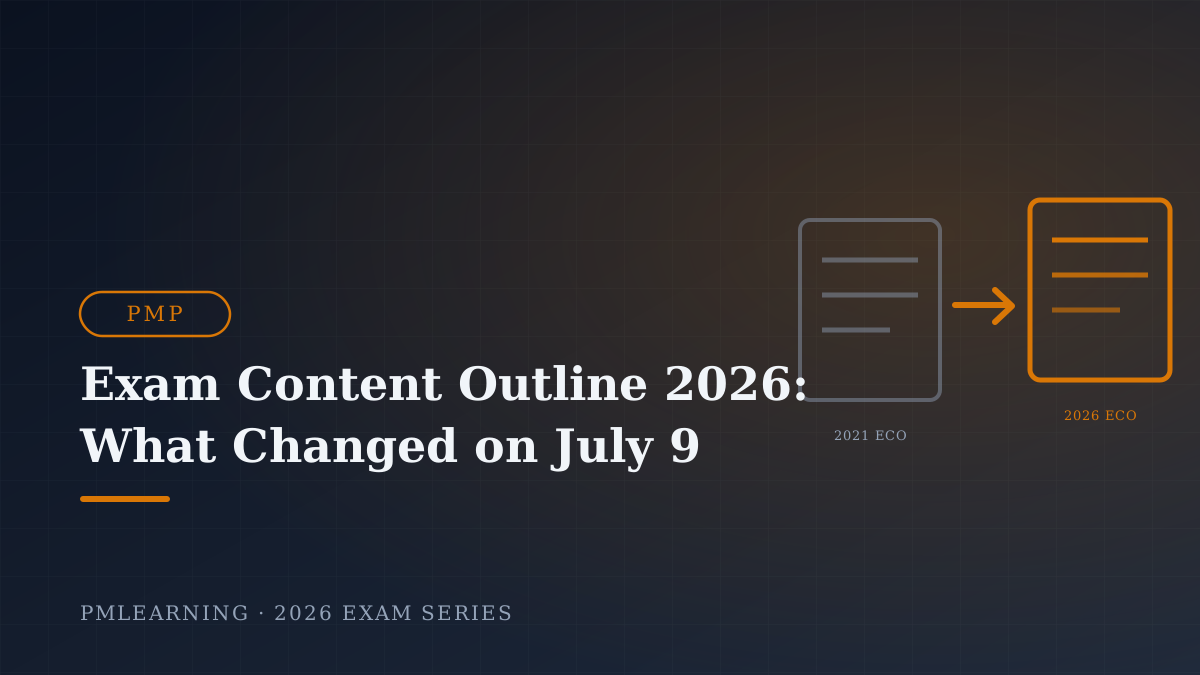
If you've been anywhere near a PMP study group this year, you've heard the chatter: PMI is changing the exam on July 9, 2026. And with change comes a wave of anxiety — half the people I coach are worried they're studying the wrong material, and the other half aren't sure whether to rush their exam date or wait for the new version.
So let's slow down and walk through what the Exam Content Outline actually is, what's really changing, and — most importantly — what you should do about it depending on where you are in your prep.
First, what is the PMP Exam Content Outline?
The Exam Content Outline (ECO) is the blueprint PMI publishes for the exam. Not the PMBOK® Guide — this trips up almost everyone. The PMBOK is a reference; the ECO is the test plan. Every single question on your exam maps to a specific domain, task, and enabler in the ECO. If it's not in the ECO, it's not on the exam.
That's why the first thing I tell every new student is: download the ECO from PMI's website and read it before you open any textbook. It's about 10 pages of substance. Those 10 pages tell you exactly what you're being tested on.
PMP® Examination Content Outline — 2026
The exact blueprint your exam is built from, straight from PMI. Ten pages. Read it before anything else.
Download the Official 2026 ECO (PDF)The current exam: what applies through July 8, 2026
If your exam date is on or before July 8, 2026, nothing changes for you. You're taking the exam built on the ECO that's been in place since 2021:
- People — 42% of questions: leading teams, resolving conflict, supporting performance, engaging stakeholders.
- Process — 50%: the technical craft — scope, schedule, cost, quality, risk, procurement — across predictive, agile, and hybrid approaches.
- Business Environment — 8%: compliance, benefits realization, organizational change.
Roughly half the questions lean agile or hybrid. The exam is 180 questions in 240 minutes with two 10-minute breaks. If this is your exam, stop reading news about the new version — it's noise for you. Book your date, practice under timed conditions, and get it done before the deadline.
What changes on July 9, 2026
Starting July 9, PMI launches the updated exam aligned with the PMBOK® Guide 8th Edition and a refreshed Exam Content Outline. Based on what PMI has published and what we're seeing as we rebuild our own question bank for the new format, here's where the emphasis is moving:
First, the numbers — because they change how you study more than any headline does. The three domains are the same, but the weight behind them shifts hard:
| Domain | Through July 8 | From July 9 |
|---|---|---|
| People | 42% | 33% |
| Process | 50% | 41% |
| Business Environment | 8% | 26% |
Read that last row twice. Business Environment jumps from 8% to 26% — from a slice most candidates skimmed in a weekend to more than a quarter of your exam. And it's not just bigger — it's different. In the official outline, Domain III now includes tasks that used to live elsewhere: plan and manage risk, manage and control changes, define and establish project governance, and remove impediments and manage issues — alongside compliance, continuous improvement, organizational change, and monitoring the external environment. So if I could give you only one piece of advice about the new exam, it's this: whatever study plan worked for people who passed in 2024 or 2025 under-invests in Business Environment by a factor of three, and it files risk and change control under the wrong domain entirely. Don't inherit that plan.
A few more facts worth knowing, straight from the official outline. The exam is 180 questions in 240 minutes — 170 scored, 10 unscored pretest items mixed in. The task list inside the domains gets consolidated — 26 tasks instead of 35 (8 in People, 10 in Process, 8 in Business Environment) — so each task carries more weight and shows up more often. PMI also puts a number on the approach mix: roughly 40% of questions reflect predictive approaches, and the remaining 60% split between adaptive/agile and hybrid — woven through all three domains, not parked in any one of them.
The question formats expand too. Alongside the familiar single- and multiple-response items, PMI's outline introduces case or scenario sets (a detailed situation — sometimes with graphs or charts — followed by a series of linked questions), graphic-based questions (interpret a chart, diagram, or screenshot to answer), plus matching, enhanced matching, point-and-click, and pull-down items. And one exam-day mechanic worth knowing before you sit down: there are two 10-minute breaks — the first comes after the case-study section, the second roughly midway through the independent questions — and once you start a break, you cannot return to the previous section. Review your answers before you stand up.
The case-study sets deserve special practice attention. Reading a longer scenario and answering several linked questions about it is a different rhythm than one-and-done questions — pace yourself differently there.
Beyond the structure, here's where the emphasis is moving:
- Value delivery moves to center stage. The new outline cares less about "did you follow the process" and more about "did the project deliver measurable value." PMI's own research behind the ECO reframes project success beyond schedule, budget, and scope — a project succeeds when it delivers value that was worth the effort and expense. Expect scenarios that ask you to weigh business outcomes, not just deadlines.
- AI enters the exam room. Not as a technical subject — you won't be asked how a model works — but as a project reality: leading teams that use AI tools, managing AI-assisted estimation and reporting, and knowing where human judgment must stay in the loop.
- Sustainability and ESG considerations show up as part of the business environment: environmental impact, stakeholder expectations beyond the org chart, responsible delivery.
- Predictive, Agile, and Hybrid — all three, fluently. The new outline doesn't pick a side. It expects you to move between predictive, agile, and hybrid approaches the way real projects demand — because that's what PMI is really shifting toward: what current projects actually need, and the actual problems teams face on the ground. New technology like AI is part of that reality — the exam cares about how it's used and where it genuinely helps. And underneath it all sits one idea: don't just deliver a project — deliver value the customer can feel, value that generates revenue. That's the lens the new exam judges every scenario through.
The situational, scenario-based style isn't going anywhere. PMI has spent a decade moving away from memorization questions, and the new exam continues in exactly that direction. Good judgment, applied to messy realistic scenarios — that's still the game.
So… should you take the exam before or after the change?
Here's the honest decision framework I give my students:
Take it before July 8 if you're already deep into prep — you've done a few hundred practice questions and you're scoring above 70% consistently. Your material matches your exam. There is zero benefit to waiting, and waiting means restudying against a new outline.
Wait for the new exam if you're just starting now, in July 2026, and realistically need 8–12 weeks of prep. You'd be racing an exam deadline for no reason. Start fresh against the new ECO and take the exam you'll actually be given — and give Business Environment the seat at the table it now demands. A quarter of your exam lives there.
Whatever you do, don't straddle. The worst position is preparing with 2021-era materials for an exam you'll sit in August 2026. Check which version your exam date lands on, then match every study resource to that version.
Every question maps to this exact document.
Every single question, quiz, and simulator exam created on PMLearning is meticulously mapped to the tasks and enablers of this updated 2026 PMI ECO. When you practice here, you are practicing the exact scenarios, domains — People, Process, Business Environment — and question formats you will face on your actual exam day.
Try 30 Free 2026-Aligned QuestionsHow to check your study materials are aligned
Three quick tests for any course, book, or question bank:
- Does it state which ECO it's aligned with — explicitly, with a date? Vague "updated for the latest exam" claims are a red flag.
- Do its practice questions feel situational? If you're seeing "which of the following best defines…" questions, the material is stale regardless of what the cover says.
- Does the domain weighting of its mock exams match the ECO you'll be tested on?
Our own PMP exam simulator serves the current exam format through July 8, and our fully rebuilt 2026 question bank goes live with the new exam. If you want to feel the current question style first, start with the free PMP practice exam — 25 real scenario questions, no signup.
The bottom line
Exam changes always generate more fear than they deserve. PMI isn't reinventing project management on July 9 — it's updating the blueprint to match how projects actually run in 2026: hybrid by default, assisted by AI, judged on the value they deliver. The fundamentals that pass the exam — calm judgment, collaboration, analyze-before-acting — are the same fundamentals that have passed it for years.
Read the ECO for your exam date. Match your materials to it. Practice under real conditions. That's the whole strategy, before and after the change.
0 Comments
Be the first to share your thoughts!