
Back to Articles
PMP
Case Study
When a Key Stakeholder Demands Scope Creep During Construction
P
PMLearning Curriculum Team
June 23, 2026 · 3 min read
1 The Scenario
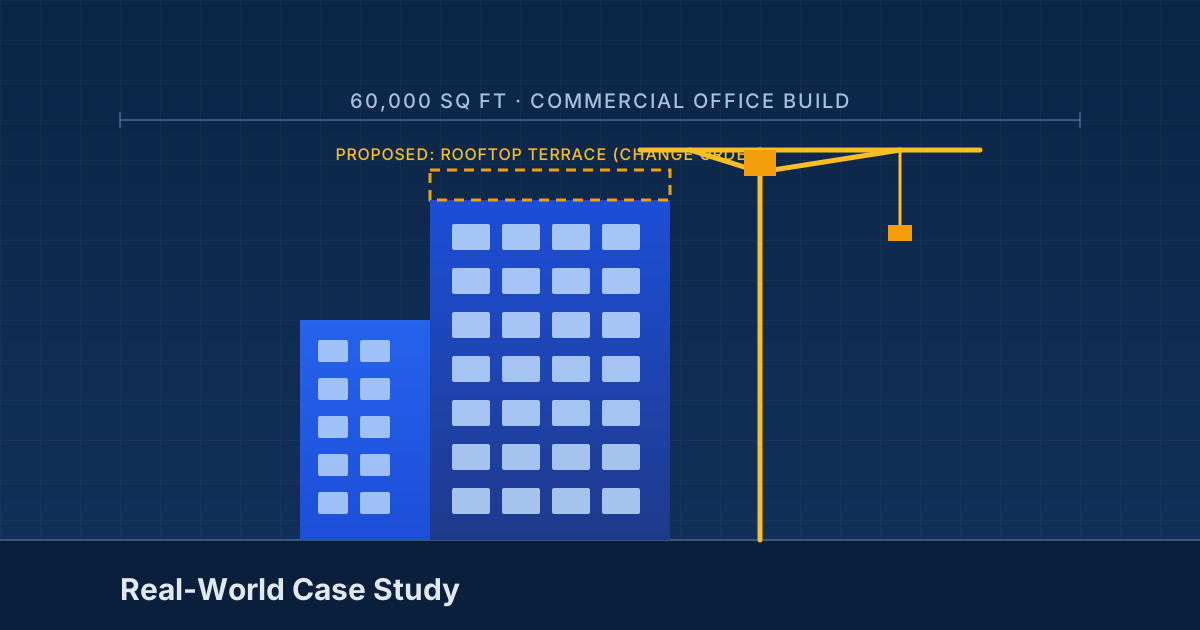
You are the project manager on a 14-month build of a 60,000-square-foot commercial office building in Austin, Texas, delivered under a predictive (plan-driven) approach. The project is in the construction phase and tracking to its approved scope, schedule, and cost baselines. About five months in — with framing complete and MEP rough-in underway — the client's VP of Facilities, a powerful sponsor-adjacent stakeholder, walks the site and tells your superintendent to "go ahead and add" a rooftop terrace and an extra bank of exterior glazing. The superintendent, wanting to keep the client happy, directs the crew to start prepping for it. You only discover this at the weekly owner-architect-contractor (OAC) meeting when the schedule update shows slippage against baseline and committed costs creeping up.
The Challenge: What Would You Do?
The VP of Facilities carries real organizational influence and could shape future contract awards for your firm. The rooftop terrace and added glazing are not in the approved scope baseline, have no change order, and no impact analysis — and they carry structural, permitting, and inspection implications. Push back too hard and you damage a key client relationship; quietly allow it and you breach your scope baseline, schedule, and budget, and undermine the integrity of your change control process. What is your correct first action?
✓ The PMI-Aligned Resolution
On a predictive project, change is expected — but it is governed, never absorbed informally. The PMI-aligned response is to follow Perform Integrated Change Control: you neither simply accept nor flatly reject the request. First, stop the unauthorized work and ask the VP to submit the request through the formal change order process. Then analyze its impact across scope, schedule, cost, and risk — including the structural, permitting, and inspection consequences — and route it to the Change Control Board (CCB) for a decision. The CCB has two legitimate predictive outcomes: (1) approve the change order and update the baselines — which, to protect the schedule and budget, typically means swapping it for lower-priority scope or formally extending time and cost; or (2) defer the request to a later phase or a separate follow-on project so it can be designed, permitted, and scheduled deliberately rather than squeezed in mid-construction. You preserve the relationship by engaging the VP professionally — acknowledging the value of the idea and explaining it will be assessed properly — rather than rejecting it outright.
Exam Application & Takeaway
- ▸On a predictive project, change is expected but governed — it must enter Integrated Change Control (a formal change order) before any work begins; it is never absorbed informally.
- ▸Unapproved work, however well-intentioned, is scope creep — pause it and convert the request into a formal change order.
- ▸Impact analysis (scope, schedule, cost, risk — plus structural, permitting, and inspection impacts in construction) always precedes any commitment to a change.
- ▸The Change Control Board — not the PM alone, and not a stakeholder — authorizes baseline changes. Approved changes mean updated baselines (often a scope swap or a formal time/cost extension); otherwise the request is deferred to a later phase or follow-on project.
- ▸On the exam, the "first" action in scope-pressure scenarios is almost always to follow the change control process — not to immediately agree, refuse, or quietly accommodate the work.